
|
|
There are 5 products in the VIIRS VI suite:
The first two products directly ingest daily level 2 gridded (L2G) product surface reflectance (VIIRS series). The last three products use the VNP13A2 product and aggregate it through time and/or space (Figure 1). For the CMG products spatial averaging and reprojecting from sinusoidal to geographic lat/lon is performed. For the 16-day products, two sets of 16day compositing datasets are produced each 8-day apart. Datasets labeled as Regular production have a compositing period as 1-16, 17-32, 33-48, etc and datasets with Phased production have a compositing period as 9-24, 25-40, 41-56, etc. This parallel production allows to have a 16day composited value each 8-day, also allows a direct comparison to MODIS Terra and Aqua for comparison and continuity purposes.
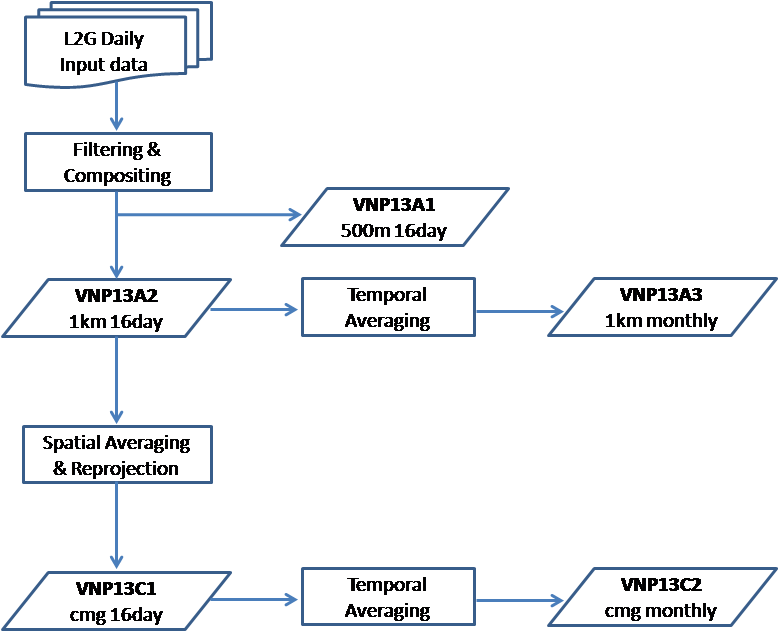
Figure 1. VI products flow chart production
The VI processing algorithm operates on a per-pixel basis and requires multiple observations (days) to generate a composited VI. The algorithm applies a filter to the data based on quality, cloud and viewing geometry. Cloud contaminated pixels and extreme off-nadir sensor views are considered lower quality. A cloud-free, nadir view pixel with no residual atmospheric contamination represents the best quality. The goal of the compositing methodology is to extract a single value per pixel from all the retained filtered data, which is represententavive of each pixel over the particular 16-day period. The VI compositing technique uses an enhanced criteria for normal to ideal observations, but switches to an optional backup method when conditions are less than ideal. These techniques are Constrained View Angle - Maximum Value Composite (CV-MVC) and Maximum value Composite (MVC) (Figure 2). For a detailed description of the methods refer to the Users Guide.
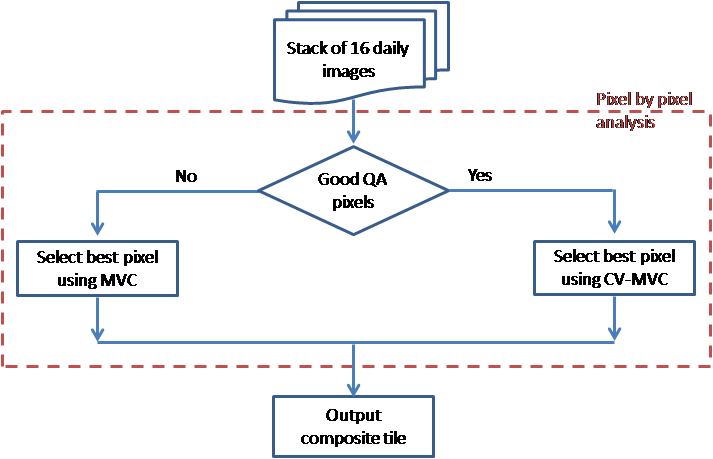
Figure 2. VI products compositing

